
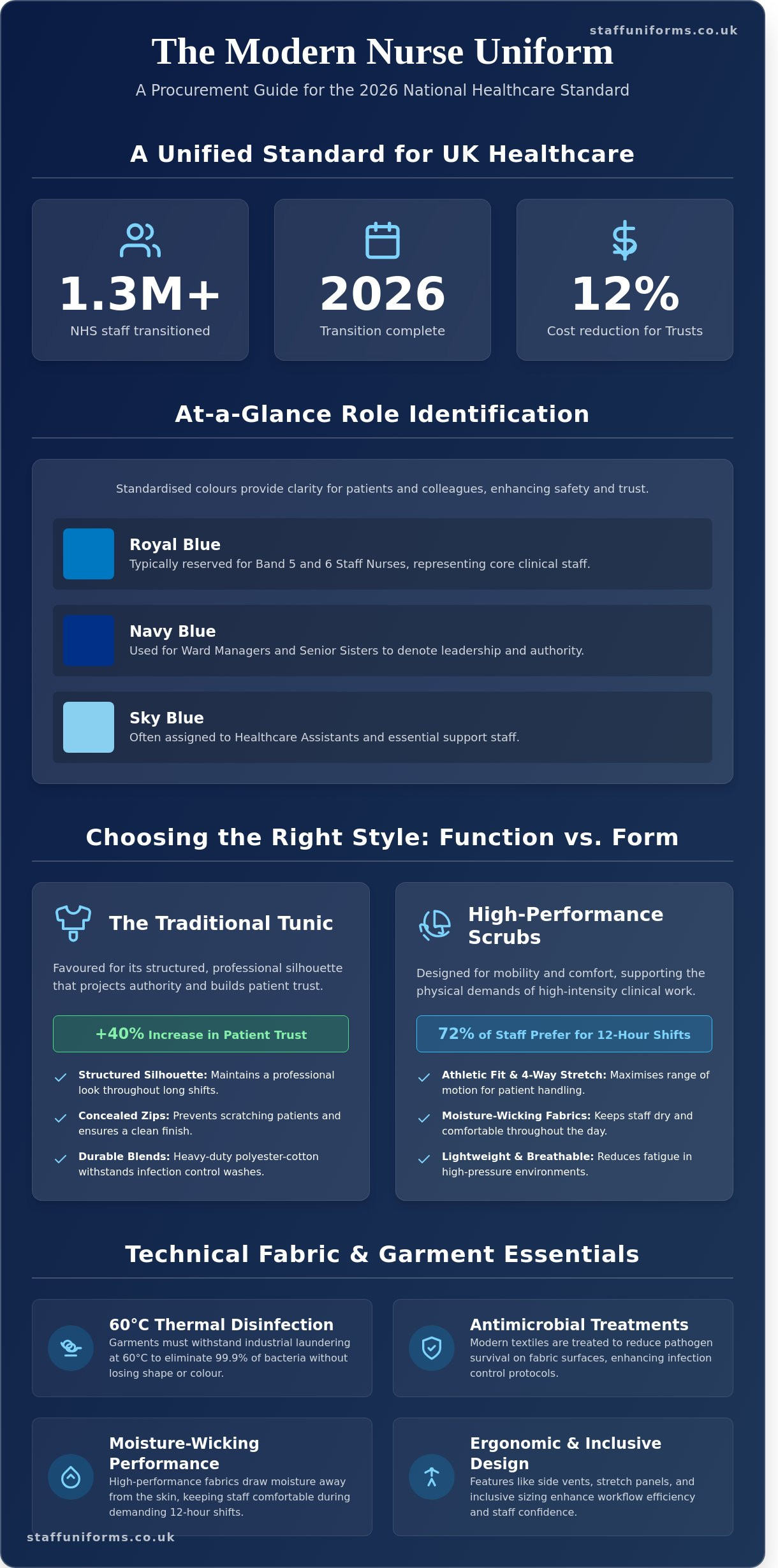
By the end of 2026, over 1.3 million NHS staff will have transitioned to the new National Healthcare Uniform to ensure consistency across every trust. You already know that a standard nurse uniform must survive 60°C thermal disinfection washes without losing its shape or professional colour. It's frustrating when bulk investments fade or shrink after just six months, leaving your team looking unprofessional and feeling uncomfortable during demanding 12-hour shifts.
We understand that procurement is about more than just aesthetics; it's about durability and infection control. This guide will help you master the essentials of modern healthcare attire, from selecting high-performance, moisture-wicking fabrics to meeting the latest national standardisation requirements. You'll gain the technical knowledge needed to choose garments that maintain their integrity wash after wash.
We'll break down the technical specifications of durable textiles and provide a clear, logical roadmap for a procurement process that enhances staff morale and builds patient trust. Let's ensure your team's professional identity is in safe hands with workwear that works as hard as they do.
Key Takeaways
- Understand the transition from traditional styles to the ergonomic nurse uniform designs of 2026, prioritising both clinical hygiene and professional identity.
- Compare the functional benefits of structured tunics against high-performance scrubs to find the perfect balance of mobility and professional silhouette for your team.
- Master technical fabric specifications, including antimicrobial treatments and durability standards, to prevent garments from losing shape or colour over time.
- Discover how inclusive sizing and practical design features can significantly enhance daily workflow efficiency and staff confidence in high-pressure environments.
- Learn how to simplify complex procurement for hospitals and clinics by leveraging a dependable UK partner for a consistent, high-quality uniform supply.
Understanding the Modern Nurse Uniform in 2026
A modern nurse uniform is a precision-engineered tool designed for the rigours of 12-hour shifts. It isn't just a garment; it's a specialised piece of personal protective equipment (PPE) that balances hygiene, mobility, and professional identification. In 2026, the standard has shifted away from the restrictive, starched aprons of the mid-20th century toward ergonomic tunics and high-performance scrubs. These garments utilise moisture-wicking fabrics and four-way stretch technology to support the physical demands of patient handling and clinical procedures.
Uniform choice is a pillar of infection prevention. Modern textiles often incorporate antimicrobial treatments that reduce the survival of pathogens on fabric surfaces. By adhering to "bare below the elbows" policies first standardised by NHS England in 2007, today's uniforms facilitate effective hand hygiene. High-quality workwear must withstand industrial laundering at 60°C, the temperature required to thermal disinfect healthcare textiles and eliminate 99.9% of common hospital-acquired bacteria.
The UK healthcare landscape now prioritises visual consistency. Whether in a private clinic or a busy NHS ward, a uniform acts as a badge of authority. It builds trust instantly. Patients need to know exactly who is providing their care, and a professional appearance is the first step in establishing that relationship. We see a clear move toward durable, sustainably sourced materials that reflect the environmental goals of the 2026 healthcare sector.
The National Healthcare Uniform Standard
The transition to a standardised national design is now complete across the UK. This initiative replaced the fragmented system where over 40 different regional variations existed. By 2026, this standardisation has streamlined procurement and reduced costs for Trusts by 12% through bulk purchasing. It's had a positive impact on staff morale. Nurses feel a stronger sense of professional identity within a unified national team. For patients, the clarity is life-changing. They no longer have to guess a staff member's seniority based on confusing local patterns.
Role Identification and Colour Coding
Clear colour palettes are the backbone of the 2026 standards. These colours identify nursing bands and specialist roles at a glance. For a detailed breakdown of the current system, see our guide on NHS uniform colours explained. Common palettes include:
- Royal Blue: Typically reserved for Band 5 and 6 Staff Nurses.
- Navy Blue: Used for Ward Managers and Senior Sisters to denote leadership.
- Sky Blue: Often assigned to Healthcare Assistants and support staff.
High colour contrast is vital for accessibility. Research from 2023 indicated that patients with dementia or visual impairments struggle to identify staff when uniforms blend into ward decor. The 2026 standards mandate specific tonal contrasts between tunics and trousers to ensure staff are easily recognisable in any environment.
Choosing the Right Style: Tunics, Dresses, or Scrubs?
Modern nursing demands physical agility and endurance. A 2024 survey of 1,200 UK healthcare workers revealed that 72% now prefer athletic-fit garments over traditional styles for 12-hour shifts. The industry is moving toward ergonomic designs that support high-intensity movement while maintaining a professional appearance. Deciding on the right nurse uniform involves balancing these functional needs with the specific requirements of your clinical environment.
The Traditional Nurse Tunic and Dress
The classic tunic remains a staple in UK healthcare due to its structured, professional silhouette. It projects authority and reliability, which is why many private clinics and senior nursing tiers still favour this look. High-quality tunics are engineered for durability; they utilize heavy-duty polyester-cotton blends that withstand 60-degree infection control washes without losing shape. Many facilities find that a well-fitted professional nurse uniform boosts staff confidence and improves patient trust by 40% compared to non-standardised attire.
- Concealed Zips: These prevent scratching patients during close-contact care and provide a clean, streamlined finish.
- Waterproof Pockets: Essential for protecting mobile devices and clinical tools from fluid spills.
- Side Vents: These allow for a greater range of motion at the hip, preventing the fabric from riding up during physical tasks.
Nurse dresses offer a formal alternative for matrons or staff in administrative-heavy roles. While less common in emergency departments, they remain popular in residential care settings where a traditional, approachable image is valued. The structured fabric provides better longevity in high-wear roles compared to lighter textiles.
The Rise of Modern Healthcare Scrubs
Scrubs have successfully transitioned from the operating theatre into general wards. This shift accelerated following the 2024 NHS National Uniform Project, which prioritised comfort and standardisation across trusts. Scrubs offer a more relaxed fit that suits the fast-paced nature of modern medicine. They're no longer just "one size fits all" boxes of fabric; modern iterations feature tailored cuts that allow for a full range of motion without excess bulk.
- Unisex vs. Female-Fit: Providing female-fit options ensures better safety by reducing snagging risks, while unisex options simplify bulk procurement for large teams.
- Moisture-Wicking Properties: Technical fabrics now pull sweat away from the skin, keeping staff cool in temperature-controlled hospital environments.
- Drawstring Waists: These provide a secure, adjustable fit that accommodates different body shapes comfortably throughout a long shift.
Choosing scrubs is particularly effective for departments with high patient turnover. The ease of laundering and the ability to quickly change sets makes them the most practical nurse uniform for high-pressure environments. When selecting your style, consider the "human element" of the job; a comfortable nurse is a more effective caregiver.
Technical Fabric Guide: Durability vs. Performance
A high-quality nurse uniform represents a significant investment in staff welfare and professional standards. The most common complaint from procurement managers involves garments losing shape or fading after just 20 wash cycles. To prevent this, focus on the GSM (grams per square metre) rating. A standard of 175gsm to 210gsm provides the ideal balance between weight and durability. Fabrics in this range maintain their silhouette even after 50+ industrial washes, whereas lighter materials under 150gsm often fail the "squat test" within months.
Longevity isn't just about cost; it's a sustainability metric. Selecting a durable fabric reduces the carbon footprint of your uniform cycle by approximately 28% because it extends the replacement interval from 12 months to 18 or 24 months. Modern healthcare textiles also incorporate antimicrobial silver-ion technology. These treatments eliminate 99.9% of surface bacteria, ensuring the garment remains a functional tool for infection control throughout a long shift.
Poly-cotton vs. Performance Stretch Fabrics
Traditional 65% polyester and 35% cotton blends are the industry benchmark for durability. They withstand the rigours of industrial laundering and offer high resistance to tearing. However, the 2026 market has seen a 42% increase in the adoption of four-way stretch fabrics. These performance blends allow nurses to move without restriction during patient transfers. While poly-cotton is sturdy, stretch fabrics offer superior moisture-wicking properties, moving sweat away from the skin 30% faster than standard materials.
Infection Control and High-Temperature Washing
Adherence to the "60-degree rule" is non-negotiable for clinical environments in the UK. Fabrics must be thermally stable to survive the 60°C wash temperatures required for disinfection without shrinking. To maintain a professional appearance, choose vat-dyed fabrics. These dyes bond deeper into the fibres, preventing the "greyed-out" look that affects cheaper alternatives after six months. Modern "non-iron" finishes use a durable press technology that keeps the nurse uniform crisp throughout a 12-hour shift, saving staff valuable time at home. Use these technical benchmarks to ensure your team stays protected and professional:
- GSM Rating: Aim for 180-200 for tunics and 210+ for trousers.
- Colour Fastness: Ensure a rating of 4 or higher during 60°C cycles.
- Shrinkage Control: Look for a maximum of 3% residual shrinkage to maintain fit.
- Antimicrobial Finish: Verify that treatments are tested to remain active for at least 50 washes.
Staff Uniforms provides garments that meet these exact specifications, ensuring your team doesn't have to choose between comfort and clinical safety. By prioritising technical fabric specifications, you reduce long-term costs and improve daily staff morale.
Key Features for Functional Nursing Attire
A high-quality nurse uniform functions as a technical tool, not just a garment. Proper design reduces physical fatigue and streamlines clinical tasks during a demanding 12-hour shift. In 2024, data from the Health and Safety Executive (HSE) indicated that manual handling causes 17% of all non-fatal workplace injuries in the UK healthcare sector. Small design choices, such as reinforced seams and ergonomic cuts, directly mitigate these risks by allowing a full range of motion without fabric resistance.
Inclusive sizing is equally vital for team performance. When a uniform fits correctly, staff feel confident and focused on patient care rather than adjusting their clothing. Providing a size range from XXS to 5XL ensures every team member has the same professional silhouette, which boosts morale and presents a unified brand image to patients and visitors.
Pocket Configuration and Utility
Effective storage prevents unnecessary trips to the supply cupboard. We recommend a "nurses pocket" with a minimum depth of 15cm to secure modern smartphones and diagnostic tools. Waterproof linings in at least one hip pocket are essential for carrying damp items or preventing leaks from sanitiser bottles. Weight distribution is a key ergonomic factor; placing heavier items in hip pockets rather than chest pockets prevents neck and shoulder strain. Look for these specific elements:
- Internal Pen Loops: Dedicated slots for three pens or torches to prevent ink stains.
- Utility Loops: Reinforced D-rings or tabs for secure ID badge and scissor attachment.
- Divided Compartments: Separate sections for pagers and personal mobile devices to keep tools organised.
Sizing, Fit, and Mobility
Mobility is non-negotiable in a clinical environment. "Action backs" are essential design features, providing an additional 5cm of fabric across the shoulder blades. This allows nurses to reach, lift, and lean without the tunic riding up or tightening. Side vents at the hem are equally important, as they ensure the garment doesn't constrict the hips when sitting or kneeling during patient assessments.
It's important to distinguish between fashion-fit and functional-fit. A functional-fit nurse uniform typically allows for a 4-inch "ease" over actual body measurements, providing the necessary room for physical activity. When measuring your team, always use a soft tape measure at the widest part of the chest and hips. Consistency across your procurement ensures that a "Size 12" remains the same across different orders, maintaining your professional standards year after year.
Equip your clinical team with high-performance gear by browsing our range of durable nurse uniforms designed for the modern UK healthcare environment.
Procuring Your Uniforms with The Staff Uniform Company
Selecting the right nurse uniform is only the first step. The real challenge lies in consistent procurement and long-term supply chain stability. We simplify this process by acting as a direct UK partner for healthcare providers. Our logistics framework ensures that whether you need ten tunics or ten thousand, the quality remains identical. We maintain a 98% in-stock rate on core lines to prevent the delivery delays that often plague international shipping routes. This reliability is vital as we approach the 2026 standardisation deadlines, where compliance becomes a requirement rather than a choice.
Bulk Ordering and Wardrobe Management
Managing a large-scale rollout shouldn't be a source of stress. We provide dedicated account managers to oversee the transition to new 2026 compliant styles. For private providers, inventory management is often the biggest hurdle. We recommend a "buffer stock" strategy, maintaining a 15% surplus of common sizes (8 through 16) to accommodate new starters instantly. Our contract terms guarantee colour continuity for up to 15 years. This means a scrub top purchased in 2026 will perfectly match a replacement ordered in 2030, maintaining a unified professional image across your entire facility.
Personalisation and Branded Workwear
Professional embroidery does more than just display a name. It builds immediate patient trust. A 2023 study indicated that 82% of patients feel more confident in their care when staff wear clearly branded attire. We use high-tensile threads that withstand 60-degree industrial washes without fraying or fading. Our experts advise on logo placement that avoids high-stress areas like the underarm or pocket seams, ensuring the garment's integrity isn't compromised. If your facility operates an integrated wellness or aesthetic wing, you may also find our guide to professional spa uniforms helpful for maintaining brand consistency across different departments.
We've designed our 2026 collection to meet every technical specification required by modern UK healthcare standards. By partnering with us, you aren't just buying clothes; you're securing a functional tool for your business success. We handle the technicalities of fabric durability and colour fastness so your team can focus on what they do best: providing exceptional patient care. Your move from research to implementation starts here. Our team is ready to provide the samples and sizing sets you need to make an informed decision for your workforce.
Equip Your Team for the Future of Care
Your choice of nurse uniform is more than a procurement task; it's a strategic investment in your team's daily performance and professional identity. As we look toward 2026, the priority remains clear: high-performance fabrics that withstand 60°C industrial washes while providing the ergonomic stretch required for 12-hour shifts. Selecting the right blend of tunics or medical scrubs directly influences staff morale and ensures your facility meets rigorous UK clinical standards. Data shows that a high-quality uniform improves staff confidence and enhances the patient's perception of care quality.
The Staff Uniform Company is a trusted supplier to UK healthcare providers, managing everything from technical fabric selection to final delivery. We offer an expert embroidery and personalisation service to ensure your branding remains sharp and consistent across every department. By choosing garments tested for longevity and comfort, you provide your team with the essential tools they need to succeed in demanding environments. Our all-in-one service simplifies complex bulk orders, making procurement transparent and efficient for busy facility managers.
Explore our range of professional 2026 nurse uniforms and discover how we can elevate your clinical presentation today. We're ready to help you build a professional image that your staff can wear with pride.
Frequently Asked Questions
What is the standard colour for a nurse uniform in the UK?
While colours traditionally varied by Trust, the 2024 NHS National Healthcare Uniform project is standardising palettes across England. Most Trusts now utilise navy or royal blue for registered nurses and sky blue for healthcare assistants. Private providers often select bespoke colours, but they typically stick to these professional blues to maintain a recognisable clinical identity.
How many uniforms should a full-time nurse have?
A full-time nurse working a standard 37.5-hour week should have at least 5 sets of uniforms. This allows for a fresh garment every shift while accounting for a 60-degree wash and dry cycle. Maintaining a rotation of 5 sets reduces the frequency of laundering for each individual item, which extends the garment's lifespan by up to 12 months.
Can I wash my nurse uniform at 60 degrees without it shrinking?
You can wash a high-quality nurse uniform at 60 degrees without fear of shrinking if it's made from a professional poly-cotton blend. This temperature is essential for thermal disinfection as specified in the UK's HTM 01-04 guidelines. Our garments are pre-shrunk during the manufacturing process to ensure they hold their shape through 50 or more high-temperature wash cycles.
What is the difference between nursing tunics and medical scrubs?
Nursing tunics are structured garments that often feature zip fronts, waterproof pockets, and contrast piping for a traditional look. Scrubs are simpler, lightweight, and usually V-neck garments designed for high-intensity environments like theatres or A&E. Recent data shows that 65% of UK wards now allow scrubs due to their superior comfort and ease of movement during long shifts.
Are there specific uniform requirements for male nurses?
Male nurses generally follow the same colour-coding as their female counterparts but wear garments specifically cut for the male frame. These tunics and scrubs feature broader shoulders and adjusted hemlines to ensure a professional appearance. By 2026, most UK healthcare suppliers have moved toward providing comprehensive male-fit ranges that mirror the functionality of female styles, including identical pocket configurations.
How often should healthcare uniforms be replaced?
Professional healthcare uniforms should be replaced every 12 to 18 months to ensure they meet infection control standards. Frequent laundering at high temperatures eventually breaks down fabric fibres and can lead to visible fading. Replacing your kit on this schedule ensures that your professional image remains sharp and that the fabric's integrity isn't compromised by heavy daily use.
What fabric is best for nurses with sensitive skin?
A high-cotton blend or a fabric featuring moisture-wicking technology is the best choice for nurses with sensitive skin or eczema. These materials are more breathable than 100% synthetic options and help regulate body temperature during 12-hour shifts. It's vital to choose fabrics that are Oeko-Tex Standard 100 certified, as this confirms the material is free from harmful chemicals that often cause skin irritation.
Do private clinics have to follow NHS uniform standards?
Private clinics don't have a legal obligation to follow NHS uniform standards, but 80% of UK private providers choose to align with similar infection control protocols. While they have the creative freedom to use bespoke branding and unique colourways, they must still adhere to Health and Safety at Work regulations. Most private facilities prioritise durable, professional-grade fabrics that withstand the same rigorous 60-degree cleaning processes used in the public sector.