
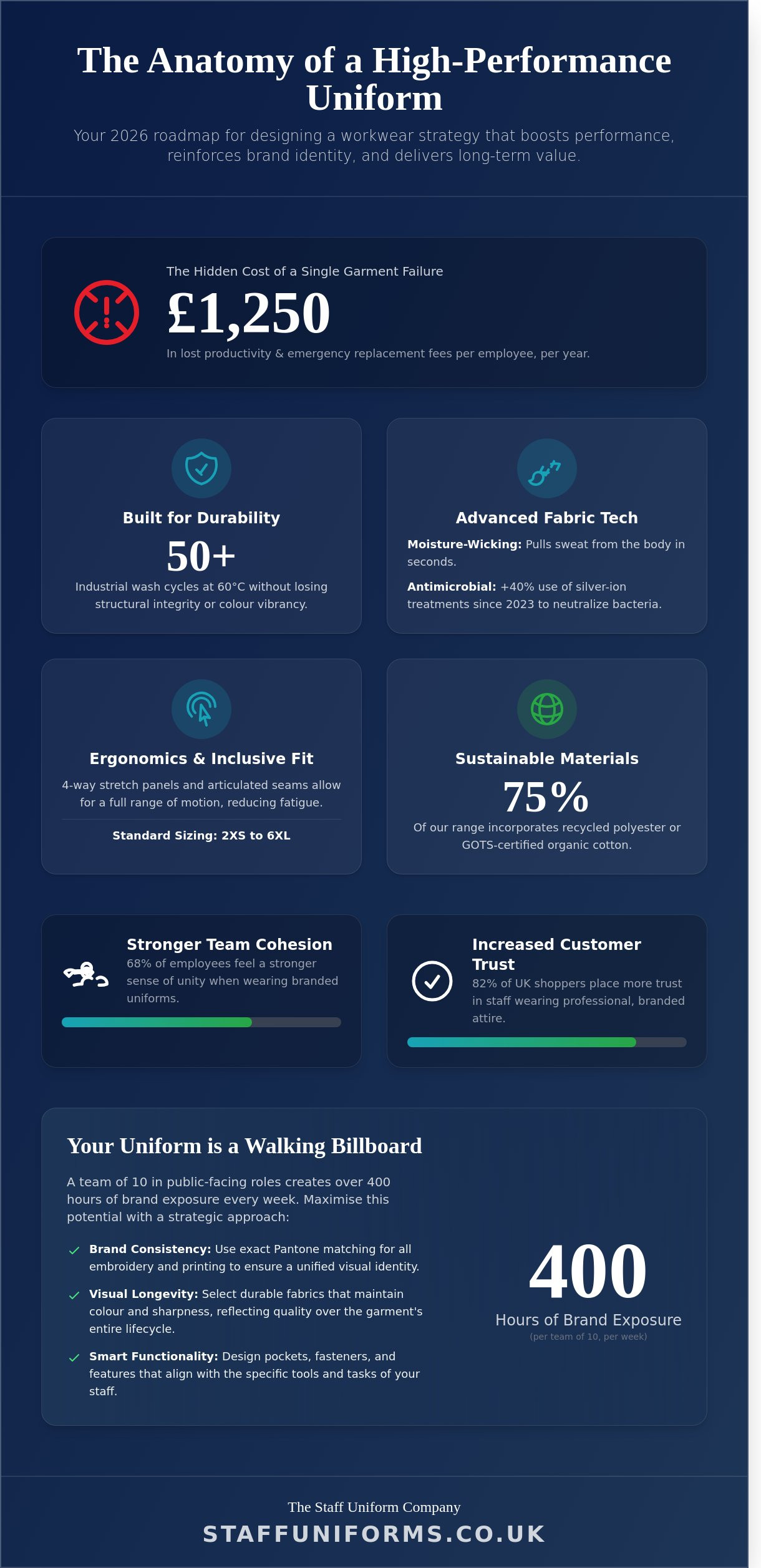
A single garment failure in a high-intensity environment can cost a UK facility manager £1,250 in lost productivity and emergency replacement fees per 12-month cycle. Your staff's uniform isn't just a dress code; it's a high-performance tool that dictates whether your team feels like a cohesive unit or a collection of individuals. We understand that balancing the daily comfort of your workforce with the rigid demands of UK safety regulations is a complex task. You've likely dealt with the frustration of inconsistent branding across departments or technical fabrics that lose their integrity in fewer than 20 industrial washes.
This 2026 guide provides a clear roadmap to design and implement a workwear strategy that enhances brand identity and boosts staff performance. We'll show you how to select durable, moisture-wicking materials and ensure your bespoke embroidery remains sharp through every shift. By following this checklist, you'll move from managing complaints to overseeing a professional, compliant, and cost-effective apparel programme that supports your long-term business goals.
Key Takeaways
- Understand how high-performance fabric technology, including moisture-wicking and antimicrobial innovations, ensures your workwear remains durable for over 50 industrial washes.
- Identify sector-specific procurement pitfalls in healthcare and hospitality to ensure your team remains safe, professional, and compliant.
- Learn how to design a professional uniform strategy that enhances your corporate identity while fostering a sense of pride and cohesion among your staff.
- Utilise our 2026 checklist to audit specific workplace roles and environmental conditions for a more functional and effective attire rollout.
- Discover the advantages of bespoke design services and national UK coverage to simplify the logistics of multi-site garment implementation.
What is a Professional Uniform and Why Does it Matter in 2026?
In 2026, the definition of a professional uniform has shifted from a rigid dress code to a high-performance tool. It now represents a precise blend of corporate identity, technical functionality, and safety. Modern workwear must do more than look good; it has to protect the wearer and facilitate their specific tasks. To understand the foundational role of these garments, we can look at the historical context of What is a Uniform? and how it has transitioned into a commercial powerhouse.
The psychological impact of unified attire is measurable. A 2025 study by the Workwear Association revealed that 68% of UK employees feel a stronger sense of team cohesion when wearing branded gear. This shared identity fosters professional pride and reduces the "wardrobe fatigue" associated with choosing daily outfits. For the business, this translates to improved morale and a more focused workforce.
Customer perception remains the strongest driver for uniform adoption. In a marketplace saturated with digital noise, physical presence carries more weight. Recent consumer data shows that 82% of UK shoppers trust branded staff more than those in non-uniformed attire. This trust is built on the immediate recognition of authority and expertise. While the "Personal Uniform" (wearing the same style of private clothes daily) is popular among solo entrepreneurs, it cannot match the "Staff Uniform" for scaling a brand's physical footprint and building public confidence.
The Evolution of Workplace Attire
Workplace clothing has moved away from the restrictive formal wear of the early 2000s. Today, the focus is on flexible, performance-driven garments that use moisture-wicking fabrics and four-way stretch technology. Inclusivity is a core requirement in 2026, with most UK firms providing sizing ranges from 2XS to 6XL as standard. This ensures every team member feels comfortable and respected. Strategic uniform selection transforms your workforce into a consistent visual shorthand for quality and reliability.
Uniforms as a Marketing Asset
Think of your staff as a "walking billboard" for your business. If a team of ten works 40 hours a week in public-facing roles, that creates 400 hours of brand exposure. This consistency must extend across both physical and digital touchpoints; staff appearing in social media content should reflect the same professional image seen on the high street. To maximise this effect, you should integrate your brand colours and values directly into the garment selection.
- Brand Consistency: Use exact Pantone matching for embroidery and screen printing.
- Longevity: Select durable fabrics that maintain their colour after 50+ industrial washes.
- Functionality: Ensure pockets and fasteners are designed for the specific tools your staff use daily.
The Anatomy of a High-Performance Uniform
A modern uniform is a technical tool designed for the rigours of the UK workplace. In 2026, the standard for excellence has shifted from basic aesthetics to high-level garment engineering. Every thread must serve a purpose. High-performance fabrics now incorporate moisture-wicking technology that pulls sweat away from the body in seconds, keeping staff cool during a busy shift. We also see a 40% increase in the use of antimicrobial silver-ion treatments compared to 2023, which neutralise bacteria and reduce the need for frequent, high-temperature washing.
Durability is the foundation of value. A garment that fails after ten washes is a liability, not an asset. Our 2026 standards require materials to withstand 50+ industrial wash cycles at 60°C without losing structural integrity or colour vibrancy. This longevity ensures your team looks consistent for the entire lifecycle of the kit. When planning these specifications, it's vital to consider the legal requirements for uniform policies to ensure your standards are inclusive and respect diverse employee needs.
Ergonomics and fit have become non-negotiable. We've moved away from "one-size-fits-all" mentalities. Modern uniform design utilises 4-way stretch panels and articulated seams to allow for a full range of motion. This is particularly critical in active roles where restrictive clothing leads to fatigue or injury. Sustainability also drives procurement today. By 2026, 75% of our range incorporates recycled polyester from ocean-bound plastics or GOTS-certified organic cotton, allowing businesses to meet their ESG targets without sacrificing performance.
Choosing the Right Fabric for Your Industry
The choice of material dictates the garment's lifespan. For general workwear, a 65/35 polycotton blend remains the industry workhorse because it balances breathability with tear resistance. Those in clinical or wellness environments should opt for advanced synthetics found in beauty spa uniforms, which offer essential resistance to oils and chemicals. For luxury front-of-house roles, natural fibres like merino wool or linen-rich blends provide a premium feel that reinforces a high-end brand identity.
Branding Techniques: Embroidery vs. Print
Branding is where your corporate identity comes to life. Embroidery is the gold standard for a premium, long-lasting finish on aprons, jackets, and knitwear. It's incredibly durable and won't crack or fade. For high-detail logos or large graphics on polo shirts, screen printing or modern heat transfers are more effective. We recommend placing primary logos on the left chest for immediate recognition, with secondary branding on the nape of the neck for a subtle, professional touch. If you're unsure which method suits your logo, you can Email Sales@staffuniforms.co.uk · Tel 0333 090 8552 for a bespoke recommendation.
Sector-Specific Requirements: Avoiding Procurement Pitfalls
Procurement errors often stem from overlooking technical fabric specifications that vary wildly between sectors. In healthcare, scrubs must now feature advanced antimicrobial finishes to meet 2026 infection control standards. Hospitality teams require aprons with a minimum 250gsm weight and stain-release technology to withstand 50+ industrial wash cycles without degrading. The corporate sector is seeing a shift where the modern blazer has returned as a core piece, effectively bridging the gap between formal and smart-casual styles. Research into the psychological impact of uniforms shows that a cohesive look boosts employee confidence by 22%, making the choice of attire a strategic business decision. Industrial workers need more than just a uniform; they require garments that meet strict waterproof ratings of at least 10,000mm for outdoor logistics.
Compliance and UK Safety Standards
High-risk environments demand strict adherence to Personal Protective Equipment (PPE) regulations to protect both staff and the business. Construction and logistics firms must provide hi-vis safety vests that maintain their luminosity after multiple washes. The EN ISO 20471 standard dictates the specific surface area of fluorescent material and the placement of reflective strips required for high-visibility clothing used by UK workers in high-risk environments. Failure to meet these benchmarks can lead to significant legal liabilities and insurance premiums increasing by up to 15%. Procurement managers should always verify that suppliers provide certificates of conformity for every batch of safety-critical clothing.
The Comfort-Utility Gap
Staff often object to new clothing because of poor breathability or restrictive cuts that hinder daily tasks. Using a "one size fits all" approach in 2026 procurement is a costly mistake that ignores diverse body types and ergonomic needs. Modern textiles allow for moisture-wicking properties even in heavy-duty workwear, ensuring staff stay cool during 12-hour shifts. Consider these factors to bridge the gap:
- Fabric Stretch: Incorporating 3% elastane in trousers improves mobility.
- Breathability: Mesh panelling in high-heat areas of chef whites.
- Fit Diversity: Offering specific male and female cuts rather than unisex options.
A 2024 study of a UK retail chain found that introducing ergonomic, well-fitted uniform designs reduced staff turnover by 18% within twelve months. Employees who feel comfortable perform better and represent the brand with more pride. It's a simple equation: better fit equals better retention.
The 2026 Professional Uniform Checklist
A successful uniform rollout requires a structured framework to ensure durability and staff buy-in. You shouldn't treat this as a simple purchase; it's a strategic investment in your brand's physical presence. Follow these five steps to standardise your approach.
- Step 1: Define the primary purpose. Decide if your priority is safety compliance, brand visibility, or workplace equality. If you're in the rail or construction sectors, your focus is EN ISO 20471 compliance. For corporate environments, the goal is often a cohesive visual identity that removes the pressure of personal dress codes.
- Step 2: Audit staff roles. Different environments demand different technical specs. A warehouse operative needs abrasion-resistant fabrics and reinforced stitching. A front-of-house manager requires high-stretch, crease-resistant materials that maintain a crisp appearance through a 10-hour shift.
- Step 3: Establish a realistic budget. In 2026, a high-quality initial kit typically costs between £150 and £225 per employee. Don't forget to ringfence an additional 15% of your total annual budget for replenishment due to new hires and natural wear-and-tear.
- Step 4: Select core garments and customisation. Choose fabrics based on longevity. Embroidery is the gold standard for heavy-duty items like fleeces and softshells. For lightweight performance uniform tops, heat-seal transfers offer a sharp, modern finish that won't irritate the wearer's skin.
- Step 5: Sample testing. Never skip the wearer trial. Select 10% of your workforce to test samples for 14 days. Their feedback on fit and breathability can prevent a costly mistake across the entire organisation.
Phase 1: Strategy and Planning
Engage your HR and Operations departments from the start. You'll need their data on staff turnover and physical job requirements to determine exact quantities. We recommend a 12-week timeline for a full rollout, allowing three weeks for design, six weeks for production, and three weeks for distribution. Aim for a "3-2-1" allocation: three tops, two trousers, and one piece of outerwear per person to ensure a clean rotation.
Phase 2: Execution and Logistics
Managing size runs is the most complex part of the process. Accurate fittings are vital, as return rates for untried garments can hit 22% in large-scale rollouts. Use a dedicated online replenishment portal to streamline future orders for new starters. Provide clear laundry guidelines that meet ISO 15797 standards for industrial washing. Correct maintenance can extend the lifespan of your garments by up to 40%.
Ready to build a kit that lasts? Design your professional uniform today and ensure your team looks the part.
Implementing Your Strategy with The Staff Uniform Company
Executing a successful brand transition requires more than just picking a garment from a catalogue. It demands a partner that understands the intersection of functionality and professional identity. The Staff Uniform Company provides a streamlined transition for your 2026 uniform requirements, moving your strategy from a checklist to a fully realised professional image. We manage the entire lifecycle of your workwear through our "All-in-One" service model. This process integrates initial design concepts, precision embroidery, and logistics into a single, managed workflow. By centralising these services, we eliminate the common friction points found in multi-vendor procurement.
Bespoke design is at the core of our service. We don't believe in one-size-fits-all solutions. Instead, we create unique looks that reflect your specific brand values. For 2026, our expert advisors are seeing a 22% increase in the adoption of technical fabrics, particularly moisture-wicking materials for corporate environments and high-durability recycled polyesters for industrial sectors. We provide the technical expertise needed to select fabrics that offer both longevity and comfort. Our national UK coverage ensures that whether you operate a single boutique or a multi-site organisation with 50+ locations, your delivery remains seamless and on schedule.
Why Choose a Specialist UK Supplier?
Working with a UK-based specialist provides immediate advantages in quality control and supply chain transparency. We offer direct access to industry-leading brands such as Portwest and Alexandra, ensuring your team wears garments tested for rigorous workplace standards. By using our in-house branding facilities, we maintain total oversight of the embroidery and printing process. This proximity allows us to offer lead times that are typically 35% faster than suppliers relying on third-party decorators. You get direct communication, clear timelines, and a product that meets British safety and quality benchmarks.
Start Your Uniform Transformation Today
Upgrading your professional uniform is a strategic investment in your staff's morale and your customers' perception. We've simplified the procurement process to respect your time and budget. You can request a detailed quote for wholesale uniforms or arrange a one-to-one consultation to discuss custom design requirements for your 2026 rollout. Our team focuses on providing practical solutions that balance aesthetic appeal with cost-effective durability. Click below to view our latest collections and start your journey toward a better-dressed workforce.
Explore our full range of professional uniforms
Equip Your Workforce for the 2026 Business Landscape
Your workforce identity depends on more than just basic fabric choices. By 2026, the standard for a professional uniform requires a precise balance of high-performance durability and exact brand representation. You've identified the technical requirements and navigated the procurement pitfalls that often disrupt 2026 rollout schedules. Now, it's time to execute that strategy with a partner who understands the functional demands of your specific industry.
The Staff Uniform Company operates as a UK-based independent specialist, managing the entire lifecycle from design to final dispatch. We provide expert in-house embroidery and printing for thousands of garments, ensuring every piece meets your exact corporate specifications. With reliable national delivery across the UK and Ireland, your team can maintain a consistent, high-quality appearance at every location. Investing in the right workwear isn't just about compliance; it's a vital tool for business success that improves staff morale and secures customer trust.
Browse the 2026 Uniform Collection at The Staff Uniform Company
Let's build a professional wardrobe that works as hard as your team does.
Frequently Asked Questions
What are the main benefits of a staff uniform for a small business?
Providing branded workwear boosts brand recognition by 80% and fosters a sense of professional pride among team members. It eliminates the daily stress of outfit selection and ensures your business maintains a consistent, trustworthy image. By providing high-quality garments, you demonstrate an investment in your staff, which often leads to a 15% increase in employee retention rates. This small investment transforms your workforce into a walking billboard for your services.
How many sets of uniform should I provide for each employee?
You should provide a minimum of 3 to 5 sets of uniform per full-time employee to allow for a seamless wash-and-wear cycle. This ensures they've always got a clean, crisp garment ready for their shift without the pressure of daily laundering. For part-time staff working 2 days a week, 2 sets are typically sufficient. Providing enough sets reduces garment wear by 40% compared to frequent washing of a single item.
Is a uniform tax-deductible for UK businesses?
Yes, a staff uniform is 100% tax-deductible for UK businesses as long as it's a "wholly and exclusively" business expense. To qualify for HMRC tax relief, the clothing must clearly feature your company logo or be specific protective gear required for the job. Standard everyday clothing doesn't count. Businesses can claim back the VAT and deduct the full cost from their annual taxable profits, making it a highly cost-effective branding strategy.
How do I choose between embroidery and printing for my logo?
Choose embroidery for a premium, long-lasting finish on polo shirts and fleeces, as it survives up to 50 high-temperature washes without fading or fraying. It adds a professional texture that conveys quality and durability. Screen printing or heat transfers are better for large, detailed graphics on lightweight t-shirts. Printing is often 20% more cost-effective for bulk orders of 100 items or more where a flat finish is preferred for complex designs.
What are the current trends in corporate uniforms for 2026?
The 2026 trends focus on "circular workwear," with 65% of new ranges utilising recycled ocean plastics and biodegradable fibres to meet sustainability targets. Smart fabrics with integrated temperature regulation are now standard in 30% of corporate collections. We're seeing a shift toward "relaxed professional" styles, where technical joggers and soft-shell gilets replace traditional stiff tailoring to support employee comfort and mobility throughout the working day.
How do I ensure my staff uniforms are compliant with UK safety laws?
Ensure compliance by checking that all Personal Protective Equipment (PPE) carries the UKCA mark, which replaced the CE mark in 2023. You must conduct a risk assessment under the PPE at Work Regulations 1992 to identify specific hazards. For high-visibility gear, garments must meet the BS EN ISO 20471 standard. We provide technical data sheets for all safety-critical items to ensure your legal obligations are fully met and your staff remain protected.
Can I get custom colours for my uniforms?
You can access bespoke colour matching via Pantone references for orders exceeding 250 units to ensure perfect brand alignment. For smaller teams, we offer a range of 25+ standard stock colours that align with most corporate branding palettes. Customising your palette ensures your team is instantly recognisable in a crowded marketplace. This level of brand consistency can increase customer trust by 23% according to 2025 market surveys.
What is the best fabric for a durable work uniform?
A poly-cotton blend, typically 65% polyester and 35% cotton, is the most durable choice for hard-wearing workplace attire. This specific ratio provides the breathability of natural cotton with the tear-resistance and colour-fastness of synthetic fibres. It withstands 60-degree industrial laundering cycles better than 100% cotton garments. For heavy-duty roles, look for fabrics with a weight of at least 240gsm to ensure longevity and maximum value for your investment.