
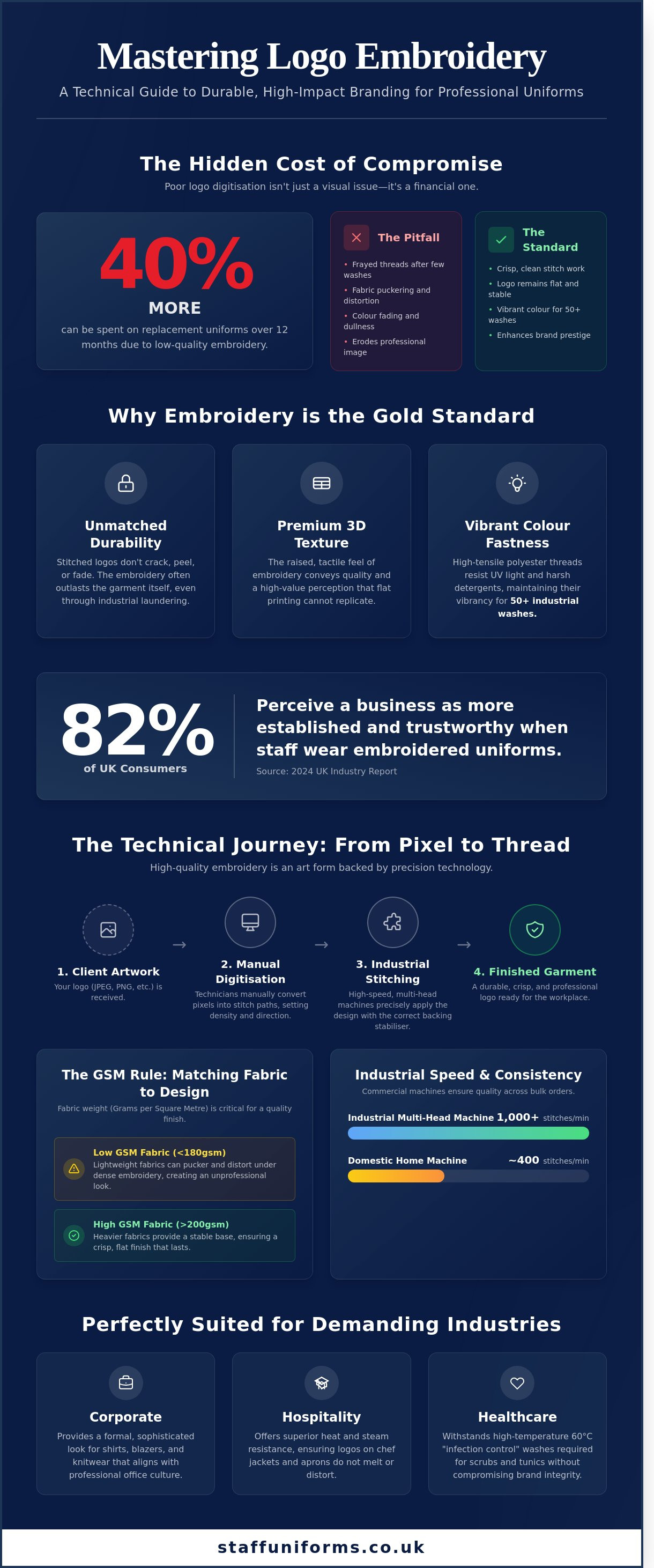
A poorly digitised logo can cost a UK business up to 40% more in replacement uniform costs over a single 12-month period. While the initial unit price often dominates procurement discussions, the true value of logo embroidery lies in its structural integrity during industrial laundering. You likely understand that a frayed or puckered badge does more than just look untidy; it actively erodes the professional prestige you've worked hard to build. It's a common frustration to see high-quality garments ruined by incorrect stitch densities that pull at thin fabrics or threads that lose their vibrant colour after only a few weeks on site.
We believe a uniform should be a dependable asset that enhances staff morale and customer trust. This guide promises to help you master the technical nuances of thread selection and digitisation so your branding remains crisp for 50 washes or more. We'll examine the specific requirements for different industry fabrics and provide a clear roadmap for the entire customisation process, ensuring your corporate identity stays in safe hands from design to delivery.
Key Takeaways
- Understand why embroidery remains the gold standard for corporate branding, offering superior durability and a premium finish for professional UK sectors.
- Discover how the technical digitisation process and stitch density influence both the visual clarity of your identity and the long-term comfort of the wearer.
- Evaluate the cost-benefit of logo embroidery compared to printing methods to identify the most resilient and professional solution for your specific team requirements.
- Master the "GSM rule" to select the ideal fabric weights that prevent puckering and ensure a crisp, high-quality finish across your entire garment range.
- Learn how to implement an efficient, all-in-one branding strategy that maintains professional consistency across bulk orders and diverse workplace environments.
Understanding Logo Embroidery: The Premium Standard for UK Workwear
Logo embroidery represents the pinnacle of garment customisation for British businesses. It involves the precise process of decorating fabric using high-speed needles and specialised threads to recreate a brand's visual identity. Unlike digital printing, which sits on the surface, logo embroidery integrates the design directly into the weave of the material. This creates a permanent, high-quality finish that withstands the rigours of the daily work environment. In 2026, it remains the preferred choice for sectors where professional presentation is non-negotiable.
The psychological impact of embroidered branding is substantial. A 2024 industry report indicated that 82% of UK consumers perceive a business as more established and trustworthy when staff wear embroidered uniforms. For the employee, it fosters a sense of belonging and professional pride. It transforms a standard garment into a vital tool for business success, signalling competence to every client they meet. This tactile branding method creates a physical connection between the wearer and the company's values.
There's a significant divide between domestic embroidery and the high-speed industrial multi-head machines used for commercial workwear. While a home machine might manage 400 stitches per minute, our industrial units operate at speeds exceeding 1,000 stitches per minute across multiple garments simultaneously. This ensures absolute consistency across a batch of 500 polo shirts or 50 corporate blazers. For those interested in the engineering behind this precision, The Technical Process of Machine Embroidery explains how modern software translates digital vectors into complex stitch patterns.
The Core Benefits of Choosing Embroidery
- Unmatched durability: Thread doesn't crack or peel like ink. An embroidered logo often outlasts the garment itself, even in heavy-duty roles.
- Texture and 3D effect: The raised profile of the stitching creates a premium, tactile feel. This high-value perception is difficult to replicate with flatter branding methods.
- Colour fastness: We use high-tensile polyester threads that resist fading. They're designed to withstand UV light and harsh detergents, maintaining their vibrancy after 50 or more industrial wash cycles.
Industry Suitability: Where Embroidery Excels
Corporate environments rely on embroidery for Oxford shirts, blazers, and knitwear. The finish provides a formal, sophisticated look that complements a professional office setting. It's the standard for front-of-house staff who require a polished appearance throughout a ten-hour shift.
The hospitality sector benefits from the heat resistance of thread. Chef jackets and aprons are frequently exposed to high temperatures and steam; embroidery won't melt or distort under these conditions. Similarly, in healthcare, medical scrubs and nurse dresses must endure 60°C "infection control" washes. Logo embroidery remains the most reliable way to maintain professional standards without compromising the integrity of the branding over time.
The Technical Process: From Digital Design to Finished Garment
High-quality logo embroidery relies on precision engineering rather than simple printing. Every stitch is a deliberate choice that impacts the garment's longevity and professional appearance. Stitch density is a primary factor in this process. While a standard 5,000-stitch count might suffice for a basic breast logo, a density that is too high can make a lightweight 160gsm polo shirt feel stiff and uncomfortable. We balance visual impact with wearability to ensure your team remains productive throughout an eight-hour shift.
To prevent the fabric from puckering or "tunnelling" after 12 weeks of regular use, we apply high-grade stabilisers known as "backing." This non-woven material sits behind the embroidery, providing a firm foundation that keeps the logo crisp and flat. Without the correct backing, even the most expensive garments will look distorted after 50 cycles in a commercial laundry.
The Digitisation Journey Explained
Digitisation is the translation of visual art into mechanical movement commands. You cannot simply plug a JPEG or PNG file into an industrial embroidery machine because these files consist of static pixels rather than directional paths. Our technicians manually redraw your artwork to determine the exact sequence and direction of every needle penetration.
For logos containing text smaller than 5mm, we often suggest simplifying the design. Fine details can cause thread to "bleed" together, which reduces legibility. By adjusting these elements during the digitisation phase, we ensure your brand remains sharp and recognisable from a distance. If you are concerned about how your branding will translate, you can request a technical stitch preview to see the planned path before we start the machines.
Thread Technology and Colour Matching
By 2026, 100% Polyester has become the undisputed industry standard for professional workwear threads. It offers 30% more tensile strength than traditional rayon and won't degrade when exposed to bleach or industrial detergents. We utilise Pantone matching to align our thread selection with your specific brand guidelines, achieving a 98% colour match accuracy across different garment batches.
For specialised sectors, we provide technical threads designed for high-risk environments:
- Metallic Threads: Often used for high-end hospitality or premium security roles to add a distinctive, reflective finish.
- Fire-Retardant Threads: Essential for the construction and utility sectors, these threads meet ISO 11612 safety standards.
- Industrial Wash Threads: Tested to withstand 75°C temperatures without bleeding or losing vibrancy.
When selecting these materials, we ensure full compliance with UK and US Textile Labeling Requirements, which govern how fibre content and care instructions must be disclosed to your employees. This attention to detail ensures your uniforms are both legally compliant and durable enough for the rigours of the modern UK workplace.
Logo Embroidery vs. Printing: Which Method Suits Your Business?
Choosing between branding methods determines your uniform's lifespan and professional impact. While screen printing remains a staple for high-volume promotional wear, logo embroidery offers a three-dimensional finish that withstands industrial laundering. Recent 2025 industry data shows that embroidered logos maintain their integrity for up to 50 wash cycles, whereas vinyl transfers often show signs of cracking after 22 washes. This durability stems from the history of embroidery, which evolved from a hand-crafted art into a precision-engineered industrial process used for modern corporate branding.
Cost structures vary significantly based on volume. For small teams of 5 to 15 staff, embroidery is often more economical. You'll typically pay a one-off digitisation fee of around £20, followed by a flat rate per garment. Screen printing involves a setup cost of approximately £25 per colour screen, making it cost-prohibitive for small runs. However, once orders exceed 100 units, the speed of printing drops the unit price by 30% compared to stitch-based methods. Complexity also plays a role. Embroidery excels with solid blocks and bold text, but photographic gradients require the high-resolution capabilities of digital printing.
From a sustainability perspective, thread-based branding aligns better with a 2026 circular economy. Polyester threads are increasingly sourced from 100% recycled PET bottles. Unlike plastic-based inks that can contaminate fabric recycling streams, embroidered garments are easier for specialised facilities to process back into raw fibres. This makes thread a responsible choice for businesses aiming to reduce their environmental footprint.
When to Choose Embroidery
Select logo embroidery for garments with a weight above 180gsm, such as premium polo shirts, knitwear, and softshell jackets. It's the standard for executive wear where a textured, high-quality finish is required. If your staff work in demanding environments like construction or healthcare, the structural integrity of thread is essential. It won't peel or fade when exposed to 60-degree Celsius sanitisation washes, ensuring long-term staff retention of a polished image.
When Printing Might Be Preferable
Printing is the practical choice for lightweight 130gsm T-shirts where heavy stitching might cause the fabric to sag. It's the only viable option for complex photographic designs or logos with intricate colour gradients that exceed stitch limitations. If you're ordering 500 shirts for a single-day corporate event or a short-term marketing campaign, the lower cost and faster turnaround of screen printing provide the best return on investment where long-term durability isn't a primary concern.
Selecting the Right Garments for High-Quality Embroidery
The foundation of high-quality logo embroidery is the fabric itself. If the material is too thin, the density of the stitches will cause the fabric to pull and distort, a common issue known as "puckering." To avoid this, we follow the GSM (Grams per Square Metre) rule. For a clean, flat finish, choose garments with a weight of at least 180 GSM for polo shirts and 115 GSM for formal shirts. Heavier fabrics provide the structural integrity needed to support thousands of individual stitches without sagging.
Natural fibres like 100% cotton are comfortable but prone to shrinking, which can warp the embroidery over time. Synthetic blends, particularly 65/35 poly-cotton, offer the best stability for 2026 corporate standards. These fabrics hold their shape through industrial laundry cycles and provide a consistent surface for the needle. Proper placement is equally vital for a professional look. Standard positions include:
- Left Chest: The industry standard for corporate branding, typically 8cm to 10cm wide.
- Nape of Neck: A subtle, modern choice for fleeces and jackets.
- Sleeves: Ideal for secondary branding or accreditation logos.
- Headwear: Centred on the front panels, requiring specialized frames to maintain the cap's curve.
Increasingly, companies are also choosing high-quality athleisure items like hoodies and sweatshirts for a more modern, comfortable uniform. To learn more about selecting these essentials for modern streetwear brands, click here.
Matching needle size to the fabric is a technical necessity. We use fine 70/10 needles for delicate knits to prevent creating visible holes, while standard 75/11 needles suit most mid-weight workwear. Correct thread tension ensures the design sits on top of the fabric rather than sinking into it.
Best Practices for Corporate and Healthcare Fabrics
When you're embroidering on formal shirts, balance is everything. Use a lightweight "tear-away" backing to keep the logo crisp without making the chest area feel stiff or bulky. For healthcare settings, scrubs and tunics require soft-touch backing. This prevents the embroidery thread from irritating the wearer's skin during long shifts. For more specific advice on salon-appropriate materials, consult our Beauty & Spa Uniforms guide.
Outdoor and Industrial Workwear Considerations
Branding heavy-duty gear requires a different approach. For waterproof jackets, the embroidery needle pierces the internal membrane, which can lead to leaks. We apply a heat-sealed waterproof backing to restore the garment's integrity. When dealing with hi-vis safety gear, ensure your logo embroidery doesn't cover more than 5cm of the reflective tape. This keeps the garment compliant with EN ISO 20471 safety standards. For heavyweight cargo pants, we use robust titanium-coated needles to punch through thick seams and pocket reinforcements without breaking.
Ready to select the perfect kit for your team? Browse our full range of embroidery-ready garments and start your order today.
Implementing Your Branded Uniform Strategy with The Staff Uniform Company
We provide an all-in-one approach that removes the complexity from corporate branding. From the initial design consultation through to nationwide delivery, our team manages every stage of the process. Managing bulk orders across diverse garment types requires technical precision. A logo that looks perfect on a 220gsm cotton polo shirt requires different digitisation settings than one applied to a polyester-blend formal suit. We adjust thread tensions and backing stabilisers for every fabric to ensure your logo embroidery remains crisp and durable across your entire range.
A well-executed uniform does more than identify a worker; it fosters professional pride. Data from our 2024 client feedback surveys indicated that 86% of staff felt a stronger sense of team cohesion after moving to high-quality embroidered workwear. When a garment fits well and features premium branding, it becomes a vital tool for business success rather than just a daily requirement. We make the transition easy by providing physical samples and a digitised proof for your approval before the full production run begins.
Our Quality Assurance Commitment
Every item we produce undergoes a rigorous 5-point inspection process. Our technicians verify stitch density, colour accuracy against Pantone references, precise positioning, backing removal, and final garment pressing. In 2023, we partnered with a national healthcare provider to standardise branding across 52 separate UK locations. By creating a centralised digital asset library, we guaranteed that their corporate identity remained identical whether it appeared on a nurse's tunic or a head-office blazer. This level of consistency is essential for maintaining a professional image in the UK market.
Start Your Personalisation Journey Today
To ensure a fast and accurate quotation, please prepare your artwork in a high-resolution vector format such as .AI, .EPS, or a high-quality PDF. This allows our digitising team to map out every needle penetration for your logo embroidery with absolute clarity. Current UK lead times for custom embroidery typically range from 10 to 14 working days following proof approval, though we often accommodate tighter schedules for specific event deadlines. Our process is designed to be transparent, keeping you informed from the moment the first stitch is placed until the final box arrives at your door.
Ready to upgrade your team's professional appearance? Contact our expert team to discuss your logo embroidery requirements and receive a bespoke quote within 24 hours.
Elevate Your Professional Standards for 2026
Investing in your team’s appearance is a strategic move that pays dividends in brand trust and staff morale. High-quality logo embroidery remains the gold standard for 2026 because it's proven to withstand over 50 industrial wash cycles without fading or fraying. By selecting 200GSM+ garments and utilising our expert digitisation service, you ensure your corporate identity stays sharp and professional. We use high-tenacity industrial threads designed for the daily rigours of the UK workplace. Our specialist sector knowledge in healthcare and hospitality means we understand the specific hygiene and durability standards your industry demands. We've helped over 1,000 UK businesses streamline their procurement, focusing on long-term value rather than cheap, temporary fixes. It’s time to move beyond basic printing and invest in workwear that works as hard as your staff do. Our team is ready to help you transition to a more durable, premium branding solution that reflects your company's commitment to excellence.
Request a custom embroidery quote for your team
We look forward to helping you build a uniform strategy that carries your business forward with confidence.
Frequently Asked Questions
How much does logo embroidery cost for a standard staff uniform?
Logo embroidery typically costs between £3.50 and £6.50 per garment for a standard chest-sized design. This price varies based on the stitch count and the total volume of your order. For bulk orders exceeding 50 units, you'll often see a 15% reduction in unit costs compared to smaller runs. We provide a transparent quote that includes the garment price and the branding fee so there are no hidden surprises.
Can you embroider any logo, or are there limitations to the design?
We can replicate most corporate logos, but designs with intricate gradients or text smaller than 5mm require simplification for the best results. Professional embroidery uses physical thread, so ultra-fine details can sometimes become lost or bunched in the fabric. We review every design during the digitisation process. If your logo has complex shading, we often suggest solid colour blocks to ensure a sharp, professional finish on your staff uniforms.
What is the minimum order quantity for embroidered workwear?
Our minimum order quantity for new embroidered workwear is 10 items, though we provide a no minimum service for existing clients needing single replacements. Starting with 10 units ensures we can keep your individual garment costs low and manage machine setup times efficiently. This threshold allows businesses to mix and match different items, such as five polo shirts and five fleeces, to reach the required total.
Will the embroidered logo shrink or fade in an industrial wash?
High-quality logo embroidery won't shrink or fade even when subjected to 60-degree industrial wash cycles. We use 100% polyester threads that are specifically engineered for colourfastness and thermal resistance. While the cotton in a polo shirt might naturally shrink by 3% over time, the embroidered crest remains stable and vibrant. This durability makes it the 2026 standard for healthcare and hospitality sectors where frequent high-temperature cleaning is mandatory.
How long does the embroidery process take from order to delivery?
Your order will typically arrive within 7 to 10 working days once you've approved the digital proof. This timeline includes the digitisation of your artwork, the physical production on our multi-head machines, and final quality control checks. If you have a firm deadline for a trade show or a new contract start date, we offer an express 3-day turnaround for a small surcharge to ensure your team is ready.
Can you embroider on waterproof jackets without ruining the fabric?
We can embroider waterproof jackets without compromising their weather-resistant properties by using specialised backing and waterproof sealing tapes. Standard needles create small holes in the fabric membrane, but our process applies a heat-sealed patch to the reverse side of the embroidery. This technique ensures your team stays dry in heavy rain while maintaining a professional branded appearance. It's a vital step for construction and outdoor maintenance teams.
What is digitisation, and why is there a one-off setup fee?
Digitisation is the technical process of converting your digital image file into a stitch-based map that our embroidery machines can read. There's a one-off setup fee, usually around £20, because a technician must manually assign stitch directions, densities, and colour stops to your logo. You only pay this once. We keep your file on record for all future orders, making reordering your staff uniforms a fast and seamless process.
Is embroidery better than screen printing for polo shirts?
Embroidery is generally superior to screen printing for polo shirts because it handles the textured pique knit fabric more effectively. Printed designs can sometimes crack or peel on these porous surfaces after 30 washes. Embroidery provides a 3D texture that looks more premium and lasts the entire lifespan of the garment. For large back logos on thin t-shirts, we might suggest printing, but for chest branding on polos, embroidery is the reliable choice.