
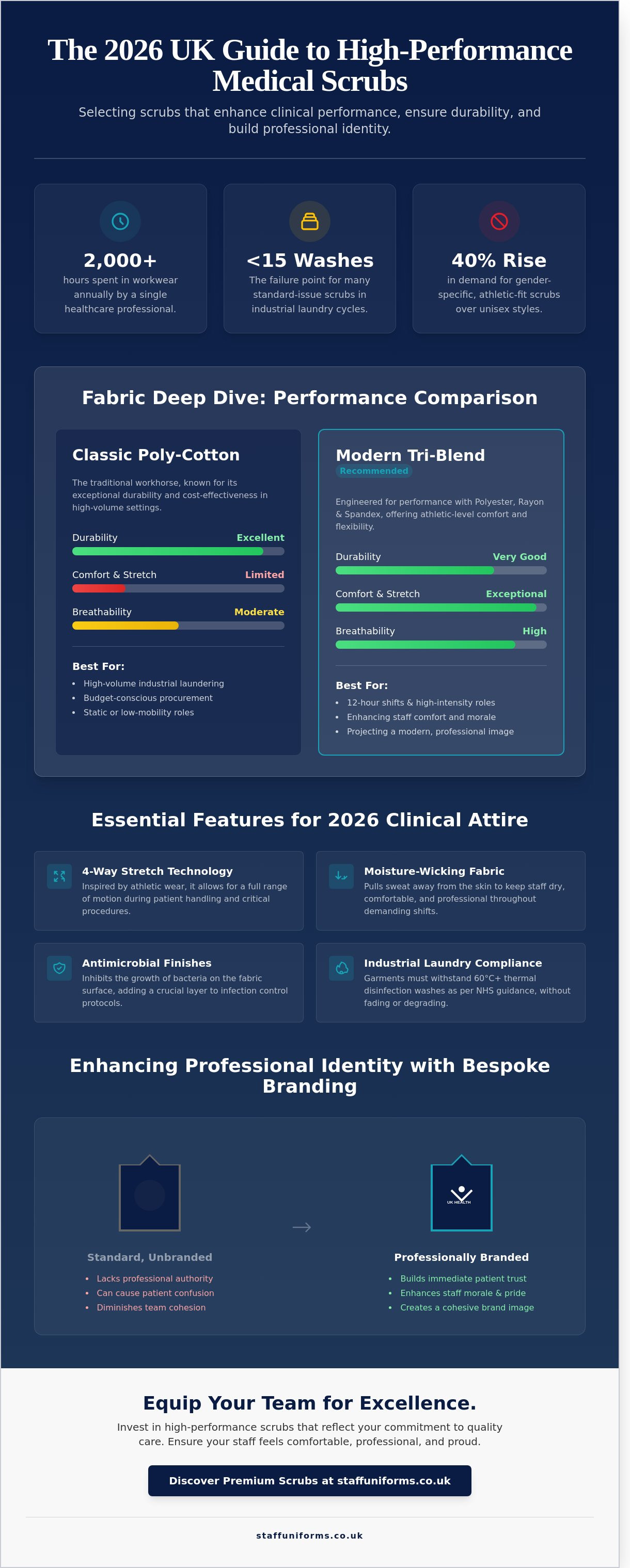
Could your choice of medical apparel be the hidden cause of staff fatigue and a diluted brand image? In the high-pressure environment of a 12-hour shift, the quality of your scrubs uk is more than just a dress code; it's a vital tool for clinical performance. Most healthcare professionals spend over 2,000 hours annually in their workwear, yet many UK facilities still settle for garments that fade, bobble, or lose their shape after just 15 industrial laundry cycles.
We know that you value professional pride and practical durability. You're likely tired of sizing inconsistencies and fabrics that don't breathe during intense patient care. This professional 2026 guide provides a technical breakdown of high-performance fabric blends and clear steps for bespoke branding. We'll show you how to select garments that maintain their integrity, compare the leading brands, and establish a streamlined procurement route that ensures your staff looks exceptional and feels comfortable from day one.
Key Takeaways
- Understand how modern clinical attire has evolved into high-performance gear designed for the rigorous demands of the 2026 UK healthcare sector.
- Master the science of fabric selection by comparing poly-cotton and 4-way stretch tri-blends to balance long-term durability with essential clinical hygiene.
- Navigate the procurement process for scrubs uk providers by using our expert strategy for bulk ordering, role-based colour coding, and industrial wash-testing.
- Identify the ideal fit profiles and brand styles-from classic to athletic-to ensure your healthcare team remains comfortable and mobile during long shifts.
- Discover how bespoke branding and professional embroidery can enhance staff morale while building immediate trust and recognition with patients.
Understanding the Evolution of Medical Scrubs in the UK
Modern medical scrubs are more than simple cotton sets; they're specialised protective garments engineered for high-intensity clinical environments. Across the UK, the healthcare sector has undergone a massive functional shift. The traditional nurse dress, once the primary staple of the NHS, has largely been replaced by universal scrub sets. This transition isn't merely a matter of style. It's a strategic move toward better infection control and professional standardisation. By 2026, the demand for scrubs uk professionals require has moved toward high-performance textiles that support the physical rigours of a 12-hour shift.
The history of surgical attire shows a clear trajectory from basic hygiene to advanced barrier protection. Modern clinical teams require gear that facilitates rapid movement while maintaining a sterile barrier. Standardising these uniforms across departments helps patients identify staff roles quickly. This clarity reduces patient anxiety and improves ward efficiency. It's about providing a reliable tool that works as hard as the person wearing it.
The Shift from Commodity to Technical Wear
User expectations have changed significantly. Healthcare professionals no longer accept basic, stiff cotton as the industry standard. They want technical wear. The 2026 market is dominated by fabrics featuring four-way stretch and moisture-wicking properties. These designs take direct inspiration from athletic wear, focusing on silhouettes that move with the body rather than restricting it. Data from the last three years shows a 40% increase in procurement requests for gender-specific tailoring. The old "one-size-fits-all" approach fails to provide the professional image or comfort that modern clinicians demand. High-quality garments improve staff morale and are a vital tool for business success in both private clinics and NHS trusts.
Scrubs vs. Traditional Healthcare Uniforms
Choosing between scrubs uk healthcare providers stock and traditional tunics depends on the specific clinical setting. While some private practices still prefer the structured look of nurse uniforms, scrubs offer superior utility for acute care and emergency environments. Scrubs eliminate the need for restrictive waistbands or delicate buttons, which is essential for manual handling tasks and patient lifting.
Colour choice also plays a psychological role in the workplace. Deep blues and greens are often associated with surgical expertise, while lighter shades are frequently used in paediatrics to appear less intimidating to children. From a regulatory standpoint, UK healthcare attire must meet strict durability standards. Garments must withstand high-temperature industrial laundering to ensure 100% decontamination. Investing in durable, professional-grade attire ensures long-term value and consistent brand representation for any medical facility.
The Science of Performance Fabrics: Choosing for Durability and Hygiene
Selecting the right material for scrubs uk professionals wear daily is a decision that impacts both staff well-being and operational budgets. Fabric technology has evolved far beyond simple cotton. Today, materials must withstand 60-degree thermal disinfection while remaining breathable during 12-hour shifts. The choice usually falls between traditional poly-cotton and modern tri-blends containing polyester, rayon, and spandex.
Tri-blends offer 4-way stretch technology. This is vital for clinical procedures requiring a full range of motion, such as patient handling or emergency response. Unlike rigid fabrics, these textiles move with the body and return to their original shape instantly. High-pressure environments also demand moisture-wicking capabilities. These fabrics pull sweat away from the skin to the garment surface for rapid evaporation. This keeps staff dry and maintains a professional appearance even during intense shifts.
Hygiene remains the priority. Modern fabrics often feature antimicrobial finishes that inhibit the growth of bacteria on the cloth. When procuring garments, it's essential to reference the NHS uniform and workwear guidance to ensure your choices align with infection prevention and control standards. These regulations dictate how fabrics must perform under rigorous industrial cleaning schedules.
Polyester-Cotton: The Durability Standard
The 65/35 polyester-cotton blend is the industry workhorse. It's engineered for high-volume industrial laundering. These garments resist piling and shrinkage over 50+ wash cycles, making them the most cost-effective choice for large healthcare trusts. They provide a crisp look that doesn't fade easily, ensuring a long-term garment lifespan for scrubs uk teams. It's a reliable balance of cost and longevity.
Advanced Fabric Treatments in 2026
By 2026, fluid-resistant coatings have become a standard requirement for enhanced personal protection. These barriers repel liquid spills, preventing blood or bodily fluids from soaking into the fibres. Odour-reduction technology is another critical update. It uses silver ion treatments to keep garments fresh during back-to-back shifts. We've seen a 30% increase in demand for eco-friendly fabrics. Recycled polyester, derived from post-consumer plastic, now provides the same performance metrics as virgin fibres without the environmental footprint.
Comparing Top Scrub Brands and Fit Styles for UK Teams
Selecting the right brand ensures your team looks unified and performs efficiently. Procurement managers must balance long-term durability with staff satisfaction. When sourcing scrubs uk wide, the choice of manufacturer dictates everything from color retention to fabric breathability.
Brand Performance Analysis
Leading manufacturers offer ranges known for their robust utility and excellent value. Certain collections provide the exceptional durability required for high-intensity hospital environments. These garments are engineered to withstand industrial laundering processes without losing their shape or professional finish. Other specialist ranges prioritize fashion-forward designs, utilizing advanced four-way stretch fabrics and moisture-wicking technology to provide extreme comfort during 12-hour shifts.
Brand consistency is vital for maintaining a professional corporate image. Standardizing your supply chain prevents the "mismatched" look that occurs when different departments order varying shades of navy or royal blue. This level of uniformity aligns with NHS England's official guidance on uniforms, which highlights how a clear professional identity fosters public confidence and supports hygiene protocols.
Finding the Right Fit for Different Roles
One size doesn't fit all in a modern healthcare setting. You'll need to consider three primary fit profiles:
- Classic Fit: A traditional, generous cut that offers maximum room for movement. It's the standard choice for general ward duties.
- Modern Fit: A more tailored silhouette that sits closer to the body. It provides a contemporary look without being restrictive.
- Athletic Fit: Designed for high activity. These often feature side rib-knit panels for enhanced flexibility.
Role-specific requirements should dictate your garment choice. Surgeons typically require minimal pocketing to avoid snagging, whereas ward nurses need multiple reinforced pockets for pens, pagers, and diagnostic tools. We're also seeing a shift in style preferences. Jogger-style scrub trousers are a major trend for 2026, particularly among younger healthcare professionals who value the tapered ankle and secure fit.
Inclusive sizing is no longer optional for large-scale staff rollouts. A successful uniform policy must include dedicated maternity scrubs and options for tall or petite staff. Proper garment draping ensures modesty and professionalism across all body types. When staff feel comfortable and their uniform fits correctly, morale improves and the focus remains entirely on patient care. Managing these specialist requirements through a single provider simplifies the procurement process and ensures every team member feels valued.
A Procurement Strategy for Bulk Purchasing and Industrial Laundering
Procuring scrubs uk for a large healthcare facility requires a shift from simple purchasing to long-term asset management. A structured strategy ensures that your investment maintains its professional appearance and protective qualities through hundreds of industrial wash cycles. Follow these four steps to streamline your procurement process.
- Step 1: Audit team requirements. Identify the specific needs of different departments. A surgeon may require high-stretch fabric, while a ward nurse needs specific pocket configurations for diagnostic tools. Role-based colour coding should be established at this stage to ensure clear clinical hierarchy.
- Step 2: Evaluate wash-test samples. Before committing to a bulk order, subject samples to 60°C industrial cycles. Measure for shrinkage and check for colour fastness. Quality garments should show less than 3% dimensional change after five high-temperature washes.
- Step 3: Calculate Total Cost of Ownership (TCO). Don't focus solely on the initial unit price. A £15 scrub set that requires replacement every six months is more expensive than a £28 set that lasts two years. Factor in the cost of laundering and the expected lifespan of the fabric.
- Step 4: Implement a managed cycle. Establish a bulk replenishment schedule or a managed uniform service. This prevents stockouts and ensures that new starters receive their uniforms on day one, maintaining professional standards across the board.
Navigating NHS Uniform Standards
The UK healthcare sector is currently moving toward standardisation. Aligning your procurement with the national NHS uniform colours is a practical move for both public and private providers. The 2026 standardisation project aims to simplify the current landscape of nearly 4,000 different uniform styles. Adopting these standards early helps patients identify staff roles quickly and reduces the complexity of sourcing replacements from multiple vendors.
Industrial Laundering vs. Home Washing
Thermal disinfection is a non-negotiable safety requirement in clinical settings. To kill pathogens effectively, uniforms must be laundered at a minimum of 60°C for at least 10 minutes. While home washing is common, it often fails to reach these consistent temperatures, and domestic detergents may not handle biological soiling as effectively as industrial chemicals. Fabric choice is vital here. Polyester-rich blends typically withstand high-heat drying better than 100% cotton, which can become brittle and lose its shape over time. To prolong garment life, avoid over-drying and ensure your laundry provider uses pH-neutral detergents that protect the fabric fibres.
Ready to upgrade your facility's workwear? View our durable range of professional scrubs designed for the rigours of industrial laundering.
Enhancing Professional Identity with Branded Healthcare Uniforms
A uniform acts as a vital tool for business success, bridging the gap between functional workwear and professional pride. In the fast-paced environment of a UK hospital or private clinic, the high-quality scrubs uk professionals wear every day directly influence staff morale. When a team feels they look the part, their confidence increases; this often leads to a measurable improvement in patient interactions and overall ward efficiency.
Branding goes beyond simple aesthetics. It serves as a clear signal of authority and expertise. Customisation options allow for position-specific titles, such as "Lead Radiographer" or "Senior Physiotherapist," which helps patients identify the right person for their needs instantly. This clarity reduces patient anxiety and streamlines communication within busy multidisciplinary teams. We focus on the human element of workwear, ensuring that every garment supports the person wearing it.
The Power of Logo Embroidery
Clinical environments require rigorous hygiene standards. We recommend logo embroidery over heat-transfer printing because it withstands high-temperature clinical washes, typically 60°C or higher, without fading or peeling. This durability ensures your investment maintains a sharp, professional look for the entire lifecycle of the garment. It's a practical solution for the long-term demands of the healthcare industry.
- Strategic Placement: We usually position logos on the left chest for maximum visibility during patient consultations and bedside care.
- Brand Differentiation: Custom branding helps private clinics distinguish their services from public healthcare providers, reinforcing a premium brand identity.
- Departmental Coding: Using specific thread colours or department names aids in rapid staff identification across large, complex facilities.
The Staff Uniform Company Advantage
We provide an all-in-one service that removes the stress of procurement for busy facility managers. From selecting technical, moisture-wicking fabrics to the final stitch of embroidery, we manage the entire process in-house. Our expertise in custom staff uniforms UK ensures that your healthcare facility receives consistent, high-standard apparel with every order.
Our team acts as a dependable partner rather than just a vendor. We understand that a well-fitted uniform is essential for safety and comfort during a twelve-hour shift. By prioritising quality and consistency, we help you protect your corporate identity. This commitment to professional pride is visible in every stitch we deliver, helping your organisation maintain its reputation for excellence in the UK healthcare sector. We make the ordering process transparent and manageable, so you can focus on patient care.
Equip Your Healthcare Team for Long-Term Success
Selecting the right medical attire is a strategic decision that directly impacts hygiene standards and staff morale. High-performance fabrics now deliver the durability required to withstand 50+ industrial washes, ensuring your investment remains professional through every demanding shift. Since 2017, we've served as a trusted partner to healthcare providers, offering technical expertise in garment selection and procurement. Finding the best scrubs uk options means balancing technical fabric performance with a clear sense of professional identity. Our in-house embroidery and branding services transform standard workwear into a vital tool for building patient trust. We handle the entire process from design to delivery, allowing you to focus on patient care while we manage your corporate image. A well-fitted, high-quality uniform is more than just clothing; it's a foundation for workplace safety and professional pride. Let's build a uniform policy that works as hard as your team does every day.
Browse our full range of professional medical scrubs and healthcare uniforms
Frequently Asked Questions
What are the best scrubs for nurses in the UK?
The best scrubs for nurses in the UK combine durability with high-performance moisture-wicking technology. When sourcing high-quality scrubs uk professionals often recommend a blend of 65% polyester and 35% cotton for maximum longevity. These materials withstand industrial laundering cycles while maintaining their shape. Look for brands that offer 4-way stretch fabrics and antimicrobial finishes to handle demanding 12-hour shifts comfortably.
Can NHS staff wear their own scrubs?
NHS staff can often wear their own scrubs if they meet the specific clinical requirements and colour coding of their individual Trust. While the NHS National Uniform Project aims to standardise healthcare attire across England by 2024, current policies still vary across the 215 separate Trusts. Always check your local infection control guidelines before purchasing. Private sets must typically be laundered at 60°C to comply with HTM 01-04 standards.
How should medical scrubs fit for maximum comfort?
Medical scrubs should offer a semi-fitted silhouette that allows for a full 360-degree range of motion without being overly baggy. You should be able to squat, reach, and lift comfortably without the fabric pulling. Ensure the waistband sits securely and the trouser hem clears the floor by at least 15mm to avoid trip hazards. A well-fitted uniform reduces physical fatigue during long shifts and maintains a professional image.
What is the best fabric blend for medical scrubs?
A blend of 72% polyester, 21% rayon, and 7% spandex is the industry standard for premium comfort and flexibility. This specific ratio provides the necessary stretch for active roles while remaining breathable. For traditional high-durability needs, a 65/35 poly-cotton mix remains the most cost-effective choice. These fabrics are engineered to resist fading and shrinking, even after 50 or more industrial wash cycles at high temperatures.
How many sets of scrubs should a full-time healthcare worker have?
A full-time healthcare worker should own a minimum of 5 sets of scrubs to cover a standard working week. This ensures you always have a clean, pressed uniform ready without needing to do laundry every evening. If you work three 12-hour shifts, 4 sets provide a necessary buffer for unexpected spills or back-to-back rotations. Having an adequate rotation extends the life of each garment by reducing the frequency of wash cycles per item.
What temperature should I wash my medical scrubs at?
You should wash medical scrubs at 60°C for at least 10 minutes to ensure effective infection control and thermal disinfection. This temperature is the standard recommended by NHS England to eliminate 99.9% of common healthcare-associated pathogens. Always wash your scrubs separately from your household clothing to prevent cross-contamination. Using a high-quality biological detergent helps break down organic stains and maintains the fabric's integrity over time.
Why are some scrubs much more expensive than others?
Price differences in the scrubs uk market usually reflect the quality of textile technology and garment construction. Premium options often feature silver-ion antimicrobial coatings, reinforced triple-stitched seams, and specialized utility pockets. These features increase the initial cost but offer better value over time. Cheaper alternatives often lack the breathability and colourfastness required for intensive clinical environments, leading to more frequent replacements and higher long-term expenditure.
How do I choose the right colour for my healthcare team?
Choosing the right colour depends on your facility's existing hierarchy and the psychological impact on patients. Research indicates that soft blues and greens can reduce patient anxiety, while darker shades like navy often denote seniority or administrative roles. In the UK, many clinics use colour-coding to help patients identify staff roles within 3 seconds of interaction. Consult with your team to select a shade that aligns with your brand identity.